This year was my 17th Golden State Star Party (that’s all of them since the 2007 Lassen Star Party) and the event is still one of my observing highlights of the year. Alan Agrawal and I gave presentations this year on Thursday and Friday nights and Dan Smiley happened to catch Alan (left) and I admiring Regulus and Mars lining up with the crescent moon during twilight on Saturday night.

Since I got asked ”How far can you see with your telescope?”, I thought I’d answer this question with a few examples of the dozens of objects I viewed in my 24-inch f/3.8 Starstructure over 5 nights.
Astronomers typically estimate the distance to remote galaxies using Hubble’s law. According to Hubble’s law, distant galaxies are receding from us (and one another) with a speed which is proportional to their distance. The recession is due to the expansion of the universe (an expanding balloon is often given as an analogy), which causes radiation from distant source to be shifted to longer wavelengths or “redshifted”. From a measurement of a galaxy’s redshift and the expansion constant, called the Hubble constant (H₀), you can determine the distance to the galaxy.
A central problem in modern cosmology, though, is that the two main methods which determine the Hubble constant yield different results, which are not quite compatible. Many measurements using a series of “standard candles” from Cepheid variables to distant type Ia supernovae give a value of about 73 km/sec/Mpc (million parsecs), while measurements using the cosmic microwave background (CMB) yield a value of 67 or 68 km/sec/Mpc. The distances I’ve mentioned below use a “compromise” Hubble constant of H₀ = 70 km/sec/Mpc.
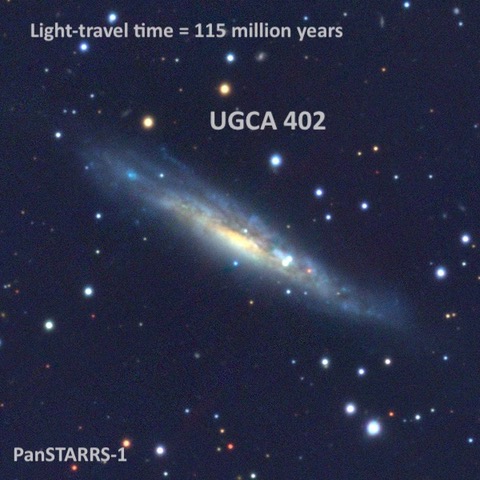
15 13 30.9 -20 40 30
V = 12.7; Size 3.5’x0.7’; PA = 62°
This faint edge-on lies in Libra just 1° WNW of the loose globular cluster
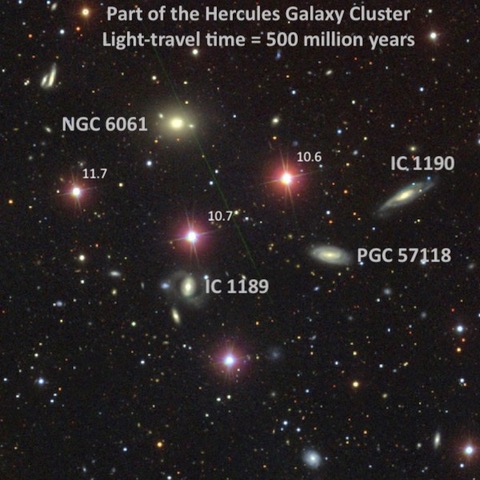
16 06 16.0 +18 15 00
V = 13.8; Size 1.0’x0.8’; Surf Br = 13.3; PA = 95°
This galaxy is located in the Hercules Galaxy Cluster (
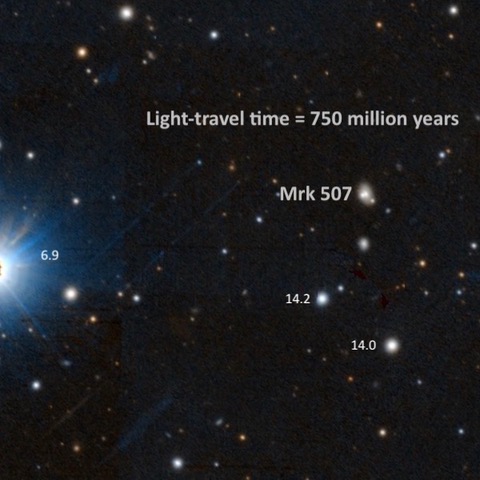
17 48 38.3 +68 42 16
V = 15.4
Markarian (Mrk) 507 in Draco is a compact narrow-line Seyfert 1 galaxy. This is a subclass of active galactic nuclei (AGN) with properties of type 1 Seyferts (both broad and narrow emission lines formed in the accretion disc of an actively feeding supermassive black hole). But this subclass displays the narrowest Balmer lines, the strongest Fe II emission (ionized iron), and extreme properties in X-rays emission.
At 375x, I found it faint, round, at most 10” diameter, visible continuously. The bright nearby star is 7th magnitude
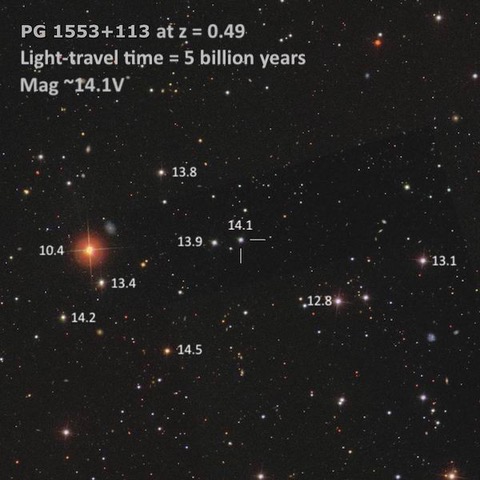
15 55 43.0 +11 11 24
V = 14.2
I told a few people who took a look in my telescope that this blazer in Serpens was 4 billion light years away, but after doing some research at home I found it was even more distant at 5 billion light years! At 14th magnitude, it was a cinch in my 24-inch at 200x and it was a snap to locate. It forms a “double” with a similar 14th-magnitude star 0.8’ east with the pair is collinear with a mag 10.4 star 4.3’ E of the blazar.
A blazar is also a type of AGN powered by a supermassive black hole (SMBH). As heated material spirals down the accretion disc surrounding the SMBH, the intense magnetic field produces high-energy, relativistic plasma jets along the polar axis. One of the these jets happens to point in our direction, so we’re looking down the throat of the jet.
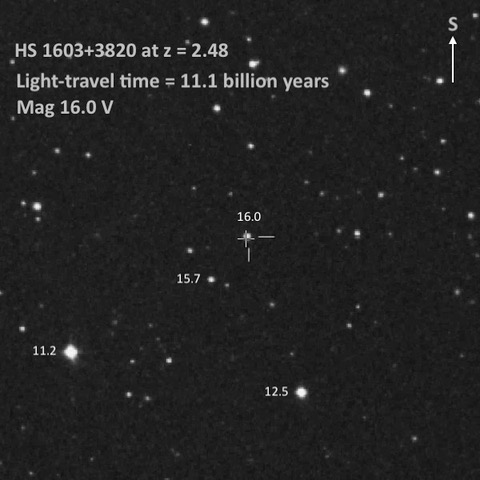
16 04 55.4 +38 12 01
V = 16.0
Although only 16.1 visual magnitude, HS 1603+3820 is an exceptionally bright quasar (and that’s saying something for quasars) in Corona Borealis. Its light left when the universe was 2.7 billion years old and has been speeding in our direction for the past 11.1 billion years. It forms the soutnern vertex of a triangle with a mag 11.2 star 4.3’ NW and a mag 12.5 star 3.3’ NNE. Averted vision clearly showed the quasar, along with a slightly brighter mag 15.8 star 1’ NW.