Quick introduction, this is Snehith from Bangalore. After a decade in IT, I transitioned to full-time farming in 2022, allowing more space for my lifelong passion for astronomy. While my primary focus is astrophotography, I also volunteer with the Bangalore Astronomical Society to conduct public outreach to promote astronomy.
This report documents my first visual sketch and observations using 8-inch and 12-inch Dobsonian telescopes. These observations were recorded during a star party in Coorg, a high-altitude location offering Bortle 4 conditions, situated roughly seven hours from Bangalore. The idea was to see the difference of these objects with two different scopes to get the aperture fever (Well that is what visual observers are calling it right ?)
Observation Log
Target 1: Jupiter (The Warm-Up)
I started with Jupiter to test the seeing conditions after collimating the 8-inch scope with help of a friend. The planet was crisp, showing the two main equatorial bands clearly and the 4 moons were visible. However, switching to the 12-inch was a revelation. The extra resolution didn’t just make it brighter but sharpened the edges of the cloud belts. I could make out irregularities in the belt, however the Giant red spot was not visible. This was also an easy target in the sky to point at and start the proceedings.
Target 2: Saturn (The Challenge)
The object was in the west and setting quickly behind the mountain area, and the 8-inch f/5 really needed me to bend giving a nice workout to my back. It was not easy to get the object into the Telrad and the scope was almost parallel to the ground. After some moving around and hunting, I brought the object to the center of the eyepiece using a 30mm one, and the rings were bright and distinct and Titan was just a small dot. I just enjoyed the 3D view and moved on.
Target 3: The Orion Nebula (M42 - First Sketch)
This was the highlight and the reason being I spent a good amount of time observing and sketching it. In the 8-inch the nebula was beautiful and glowing like a bird – more like a raptor – and I was able to resolve 3 stars of the Trapezium. I noticed a distinct greenish tint that I hadn’t expected. Moving to the 12-inch , the wings of the nebula extended much further out, looping back around to create a full wreath of nebulosity. Even though I was using a 10mm eyepiece, I still could not resolve the trapezium, not sure if it was my viewing or the sky conditions.
Random fact: I can easily identify 200+ bird species with ease, and this helped me to sketch the nebula thinking it is like a bird. It was indeed difficult without light however, I used a mild red light and covered my head area with a bed spread, sneaking out every now and then to get the shading started. The more I observed, the more I was able to identify the darker regions towards the head and wing region and I added the tones on the sketch. Then I added the stars visible when I scanned through the eyepiece, to be honest I hope these are stars :)! Here is the outcome of the sketch which thoroughly made my day and I showed it to some of the other visual observers in the early morning to get some feedback. One of them asked me if it was the Seagull Nebulla; well atleast it is still a bird haha!
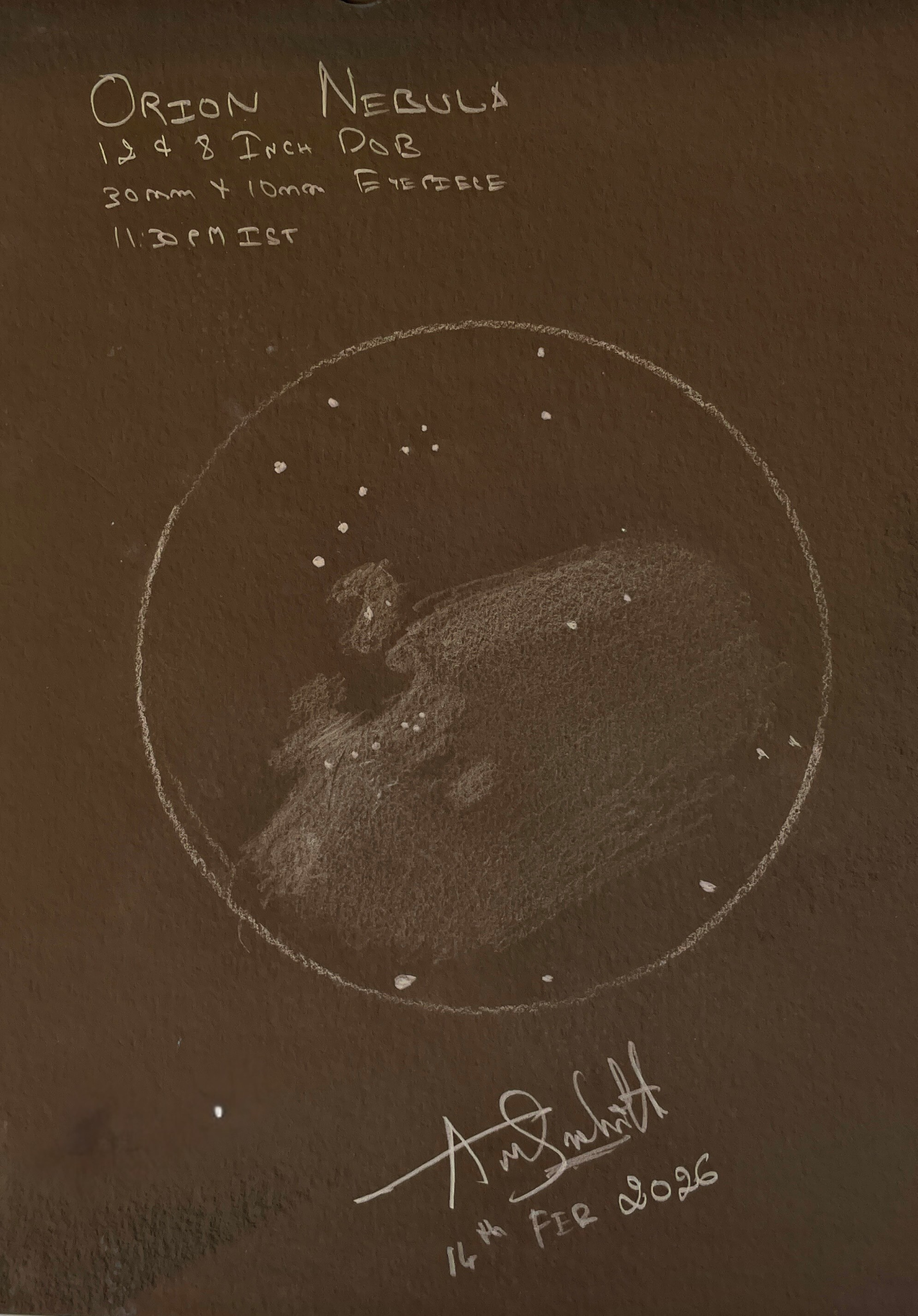
Target 4: The Crab Nebula (M1)
This was the reality check of the night. I had high hopes again. It was not easy to get the target in the Telrad because you are not looking at a bright star or a planet. With the help of Stellarium, I started to look toward Taurus, which sits high in the evening sky. Beginning at Aldebaran, the bright reddish eye of the bull, I followed the V-shape of the face upward to find the star Zeta Tauri, then moved my telescope roughly one degree towards the northwest. In my 8-inch using a 30mm eyepiece, the nebula did not appear as a bright star, but rather as a subtle, ghostly smudge of light. Because it is faint, I had to use averted vision (looking slightly to the side of the object) to allow its oval shape to materialize against the dark background.
M1 was merely a faint, oval smudge and ghostly fingerprint on the eyepiece that required averted vision to hold steady. The 12-inch made detection easier, brightening the smudge significantly, but it still refused to show the complex filaments seen in photographs. It remained a featureless, grey puff of smoke, but knowing I was looking at the wreckage of a star that exploded ages ago gave me chills considering it was a Supernova Remnant. A difficult target. Unlike the crisp stars around it, the Crab appeared as a soft, diffuse glow. No color was visible, just a grey phantom against the black sky.
I did sketch this nebula as well but it was just showing up as a poop-stuck-in-some-kind-of-haphazard-net-shaped-structure, hence not sharing it :)
Target 5: The Leo Triplet (M65 , M66 , NGC 3628 )
I finished the night with this galaxy group. Finding them was much easier since this was also my astrophotograph target for 2 straight nights. In the 8-inch M65 and M66 were obvious fuzzy ovals with bright cores but the third member NGC 3628 (The Hamburger Galaxy) was extremely faint and ghost like. The 12-inch did not make much difference but NGC 3628 popped into view as a distinct edge-on streak and I could make out the dark dust lane cutting through its center, albeit not very distinctly. It is probably because of the haziness in the sky. Seeing the galactic trio in a single field of view using a 30mm wide-angle eyepiece was simply a superb experience, M66 appeared the brightest and most distorted, while the edge on NGC 3628 looked large but diffuse.